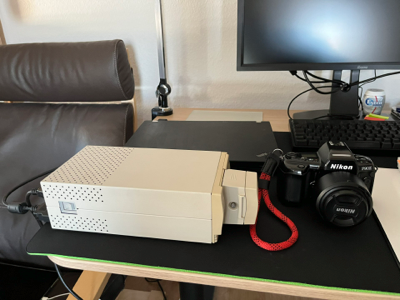
Der Nikon Coolscan war für mich als Nikon-Fan ganz klar die erste Wahl. Die „grossen" Coolscan-Modelle sind allerdings relativ teuer – deshalb habe ich mich damals für den LS-2000 (Super Coolscan 2000) bzw. den LS-30 (Coolscan III) entschieden.
Entscheidend war für mich der Streifenbetrieb: Der Scanner kann ganze 35mm-Filmstreifen verarbeiten. Genau dieses Konzept fand ich schon in den frühen 2000ern faszinierend – weil es sich „professionell" anfühlt und bei vielen Scans einfach praktisch ist.
Was ich am Coolscan liebe
• Streifen-Workflow: Ganze Filmstreifen scannen, nicht nur Einzelbilder.
• Gute Ergebnisse: Nicht der schnellste Scanner – aber die Qualität ist (auch heute noch) überzeugend.
• Coolscan-Feeling: Solide Nikon-Hardware, durchdachtes Konzept, Autofokus, „Film rein und los".
Das grosse Problem: Nur SCSI (und damit immer „Bastel-Setup")
Der LS-2000/LS-30 kommt aus einer Zeit, in der SCSI normal war – heute ist das der Haupt-Haken. Der Scanner hat keinen USB, sondern benötigt eine SCSI-Verbindung (und saubere Terminierung, Kabel, IDs etc.).
Mein Weg zum Betrieb:
1. Früher: Altes ThinkPad mit SCSI-PCMCIA-Karte – pragmatisch und stabil.
2. Später: SCSI-auf-USB-Adapter – selten und nicht günstig, aber mit VueScan am modernen PC nutzbar.
Der Nachteil, der mich am Ende zum Aufgeben gebracht hat: Mechanik & Alter
Der LS-2000/LS-30 ist Technik aus den frühen Zweitausendern (bzw. Ende 90er) – und damit ist die Mechanik heute über 25 Jahre alt. Und genau da liegt das Problem:
• Filmtransport, Zahnräder, Führungen, Sensorik – jede Mechanik geht irgendwann kaputt.
• Bei mir waren es am Ende drei Scanner.
• Einer war sogar professionell wiederaufgebaut – trotzdem: irgendwann ist Schluss.
Für mich war das der Punkt, an dem ich gesagt habe: So sehr ich die Coolscan-Idee liebe – ich brauche eine Lösung, die ich dauerhaft im Alltag nutzen kann, ohne ständig Angst vor dem nächsten mechanischen Ausfall zu haben.
Technische Daten
Nikon Super Coolscan LS-2000: Filmformate: 35mm Film (Dias & Streifen), optional IX240/APS mit Adapter. Auflösung: bis 2.700 dpi (max. 2.592 × 3.894 Pixel). A/D-Wandlung: 12-bit. Lichtquelle: 3-Farb-LED. Fokus: Autofokus. Streifenbetrieb: Random-Access, bis zu 6 Frames (SA-20). Schnittstelle: SCSI (zwei Anschlüsse, Terminierung per Schalter).
Nikon Coolscan III LS-30: Filmformate: 35mm Dias (MA-20) und Streifen (SA-20); je nach Variante auch APS/IX240. Auflösung: 2.700 dpi. Sensor: Linear-CCD (2.592-Pixel). Scanzeit (Richtwert): ca. 20 Sekunden (ohne Datenübertragung).
Fazit
Der LS-2000/LS-30 ist ein wunderschöner Scanner mit einer starken Idee: Streifenbetrieb, Nikon-Qualität, gute Ergebnisse. Aber: SCSI macht den Betrieb heute unnötig kompliziert – und die alternde Mechanik ist das echte K.-o.-Kriterium. Nach drei Geräten war für mich klar: Ich brauche etwas, das zuverlässig bleibt, auch wenn die Coolscan-Ära nostalgisch unschlagbar ist.
—
As a Nikon fan, the Nikon Coolscan was clearly my first choice. The "big" Coolscan models are relatively expensive, though – so I opted for the LS-2000 (Super Coolscan 2000) and the LS-30 (Coolscan III).
What mattered most to me was strip operation: the scanner can process entire 35mm film strips. I found this concept fascinating even in the early 2000s – it feels "professional" and is simply practical when scanning many frames.
What I love about the Coolscan
• Strip workflow: Scan entire film strips, not just single frames.
• Good results: Not the fastest scanner – but the quality is convincing (even today).
• Coolscan feeling: Solid Nikon hardware, well-thought-out concept, autofocus, "load film and go".
The big problem: SCSI only (and therefore always a "DIY setup")
The LS-2000/LS-30 comes from an era when SCSI was standard – today, that's the main catch. The scanner has no USB, but requires a SCSI connection (plus proper termination, cables, IDs, etc.).
How I got it running:
1. Earlier: An old ThinkPad with a SCSI PCMCIA card – pragmatic and stable.
2. Later: A SCSI-to-USB adapter – rare and not cheap, but with VueScan it works on a modern PC.
The drawback that finally made me give up: ageing mechanics
The LS-2000/LS-30 is technology from the early 2000s (or late 1990s) – meaning its mechanics are now over 25 years old. And that's exactly the problem:
• Film transport, gears, guides, sensors – all mechanics eventually fail.
• In my case, it was ultimately three scanners.
• One was even professionally rebuilt – and still: at some point, it's over.
That was the moment I decided: much as I love the Coolscan concept, I need a solution I can use long-term in daily life without constantly worrying about the next mechanical failure.
Technical specifications
Nikon Super Coolscan LS-2000: Film formats: 35mm film (slides & strips), optional IX240/APS with adapter. Resolution: up to 2,700 dpi (max. 2,592 × 3,894 pixels). A/D conversion: 12-bit. Light source: 3-colour LED. Focus: autofocus. Strip operation: random access, up to 6 frames (SA-20). Interface: SCSI (two ports, termination via switch).
Nikon Coolscan III LS-30: Film formats: 35mm slides (MA-20) and strips (SA-20); some variants also APS/IX240. Resolution: 2,700 dpi. Sensor: linear CCD (2,592 pixels). Scan time (guide value): approx. 20 seconds (excluding data transfer).
Conclusion
The LS-2000/LS-30 is a beautiful scanner with a strong concept: strip operation, Nikon quality, good results. But: SCSI makes operation unnecessarily complicated today – and ageing mechanics are the real deal-breaker. After three units, it was clear to me: I need something that stays reliable, even though the Coolscan era remains nostalgically unbeatable.
Quellen / Sources
• Nikon LS-2000 Reference Manual: LS2krm.pdf
• Nikon LS-2000 Fast Track Guide: LS2kftg.pdf
• Nikon Support – LS-30 Specifications: Artikel 420
• Filmscanner.info – LS-30 Testbericht: filmscanner.info
Archivfreundlich: statisches HTML, keine Cookies, kein Tracking.
© Frank Meiners · frank-meiners.de